
Published on: 19th November 2026
Out of the Loop, by Design: Building for the Agentic Enterprise
By Navin Dhananjaya, Global CXM Lead, Dentsu Global Services, and Vaibhav Bhat, Sr. Manager, Dentsu Global Services
Enterprise AI is moving from tools people summon to agents that are always on. That shift changes what we build, how we govern it, and how ambitious our programs can be.
The signal came from the edges first. Open-source projects like Clawdbot (now OpenClaw), the Grok bot, and Nous Research's Hermes Agent showed that an agent can run continuously, remember context, and act across apps without being asked. Meta's Muse, Microsoft's Scout and Autopilot, and Google's Gemini Spark are now bringing the same model to consumers and the enterprise.
For technology leaders, the question is no longer whether agents will do real work. It is how to architect an enterprise where they safely can.
From in the loop to out of the loop
Most enterprises today run AI with a human in the loop: the machine proposes, a person approves. That discipline is right, and it stays for consequential decisions. We categorize work against four positions, set by two questions: how many judgment calls the work involves, and how complex it is.
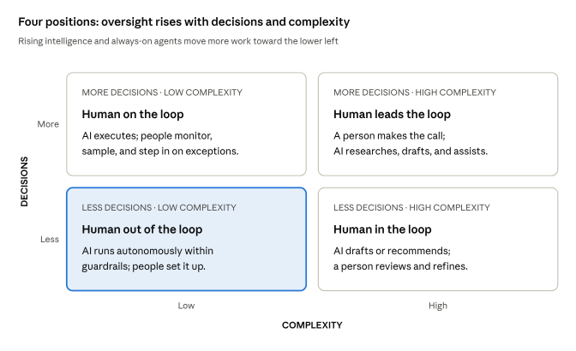
Four positions · decisions × complexity
Work with few decisions and low complexity can run out of the loop. As either rises, the human moves closer — monitoring, reviewing, then leading.
Two forces move work toward the lower left, and they compound. Rising intelligence makes complex tasks tractable for AI, so work that needed a person in the loop can shift to oversight on the loop. Always-on agentic capability — persistent memory, reusable skills, scheduled triggers, and guardrails — lets agents own more routine decisions, so work moves from on the loop to out of it.
Intelligence reduces the risk of letting agents act. Always-on capability lets them keep acting. Together they move a growing share of enterprise work out of the loop.
Orchestration on the fly, and the speed it creates
The real unlock is not a single autonomous agent. It is agents orchestrating with each other, assembling the workflow a goal needs at the moment it is needed.
A business objective becomes a chain. A planning agent decomposes it, specialist agents pull data, build and test the artifact, and check it against policy. Only the irreversible step — a release, a spend commitment, a customer-facing change — routes back to a human for sign-off.
Coordination has always been the costliest part of enterprise work: the handoffs, the queues, the waiting on other teams. When agents coordinate at near-zero cost, the time from decision to action collapses from weeks to hours.
That is what makes more ambitious programs viable. Initiatives once deferred because they needed a quarter to stand up become practical:
- Integrating a dozen fragmented data sources into one governed view
- Running hundreds of campaign or pricing variants and learning from each
- Producing tailored analysis for every account, market, or store, not just the top tier
- Keeping production systems self-healing, with people approving only high-risk fixes
The ceiling on ambition stops being team capacity. It becomes the clarity of the goals and the readiness of the systems agents must work through.
Build for people and for agents
If agents will do the work, the systems we build must be usable by agents, not only by people at a screen.
For decades, enterprise software has had one primary consumer: a person with eyes and a cursor. Dashboards are pictures, reports are PDFs, tools are interfaces. An agent cannot reliably click through a screen designed for human intuition.
The products that win the next decade will treat hooks, APIs, events, and structured outputs as first-class — as standard as the UI. Every dataset exposes a governed endpoint. Every report is also a callable service. Every workflow has a programmatic trigger and a machine-readable result. The UI becomes one door among several.
This is a transition, and it runs in three stages:
- Human-only — people operate tools directly. Most enterprise estates are here today.
- Human + agentic — the same solutions serve people and the agents acting for them, so every capability needs both a human experience and a machine contract.
- Agentic-only — applications no person opens directly, built for other agents to call, compose, and act on.
The second stage is where most organizations will live for years. The architecture decisions made now determine whether the third becomes possible.
At Dentsu Global Services, one of our major initiatives is to build solutions that serve people today and extend naturally to agentic use. We design every capability so a person can use it through a clear interface, and an agent can use it through a governed, documented contract.
In practice, that means the solutions we deliver across data, analytics, media, and customer experience are built on a few principles:
- Interface parity — anything a user can do through the UI, an authorized agent can do through an API or hook.
- Machine-readable by default — outputs carry structure, metadata, and lineage, so agents can act on them without guessing.
- Governed autonomy — each action is classified by risk, so it runs freely, runs under monitoring, or waits for human approval.
- Observable and auditable — every agent action is logged, traceable, and reversible where possible.
The goal is simple. Our clients should never have to rebuild what we deliver when their own agents arrive. The solution is ready for them on day one.
What technology leaders must plan for
Agent-ready systems are a planning discipline, not a feature toggle. Early self-hosted agents showed the risk plainly: misconfigured instances exposed credentials and could be steered through prompt injection. An always-on agent with access to email, data, and payments is a new attack surface.
Five areas need deliberate design before autonomy scales:
| Area | What it requires |
| Oversight model | A risk-based map of which work runs out of the loop, on the loop, in the loop, or with a human leading. Classify by decisions and complexity, not habit. |
| Interfaces as contracts | Versioned, documented, permissioned APIs, events, and hooks. Agents cannot improvise around a broken interface the way people can. |
| Identity, access, and memory | Distinct agent identities, least-privilege permissions scoped per action, and governed persistent memory treated as a core asset. |
| Observability and audit | End-to-end logs of what each agent did and why, with traceability and rollback for every consequential action. |
| Exceptions and escalation | Clear triggers that pull a human back in — drift, anomalies, high-stakes decisions — designed as carefully as the main flow. |
The operating model matters as much as the stack. Teams need owners for agent behavior, review cadences for autonomy thresholds, and a path to widen or narrow an agent's mandate as evidence accumulates.
Great possibilities, measured steps
The opportunity is large. Enterprises that build for agents will not just move faster; they will take on work that was previously out of reach. Humans set the ambition, and orchestrated agents carry it out.
The path there is not a leap. Start where stakes are low and actions are reversible. Prove the orchestration, instrument everything, and keep people firmly in charge of decisions with real consequence. Widen autonomy only as trust is earned through evidence.
The winners of the agentic era will not be those who automated fastest. They will be those who built with intention, extended trust step by step, and made consistent progress. Out of the loop — by design, and one deliberate step at a time.