

AI visibility in health: Are websites still relevant in a zero-click world?

For years, digital health followed a simple logic: search drives traffic, traffic drives engagement, engagement drives outcomes. That logic is losing its effectiveness.
This is where GEO - Generative Engine Optimisation - becomes relevant: the discipline of making approved content understandable, trustworthy and usable for AI-generated answers. As generative AI becomes part of everyday search behaviour, patients, caregivers and healthcare professionals increasingly receive direct answers instead of navigating through sources.
This shift raises a critical question for healthcare organisations: If AI-generated answers become the starting point of the patient journey, what role do websites still play?
From browsing to receiving answers
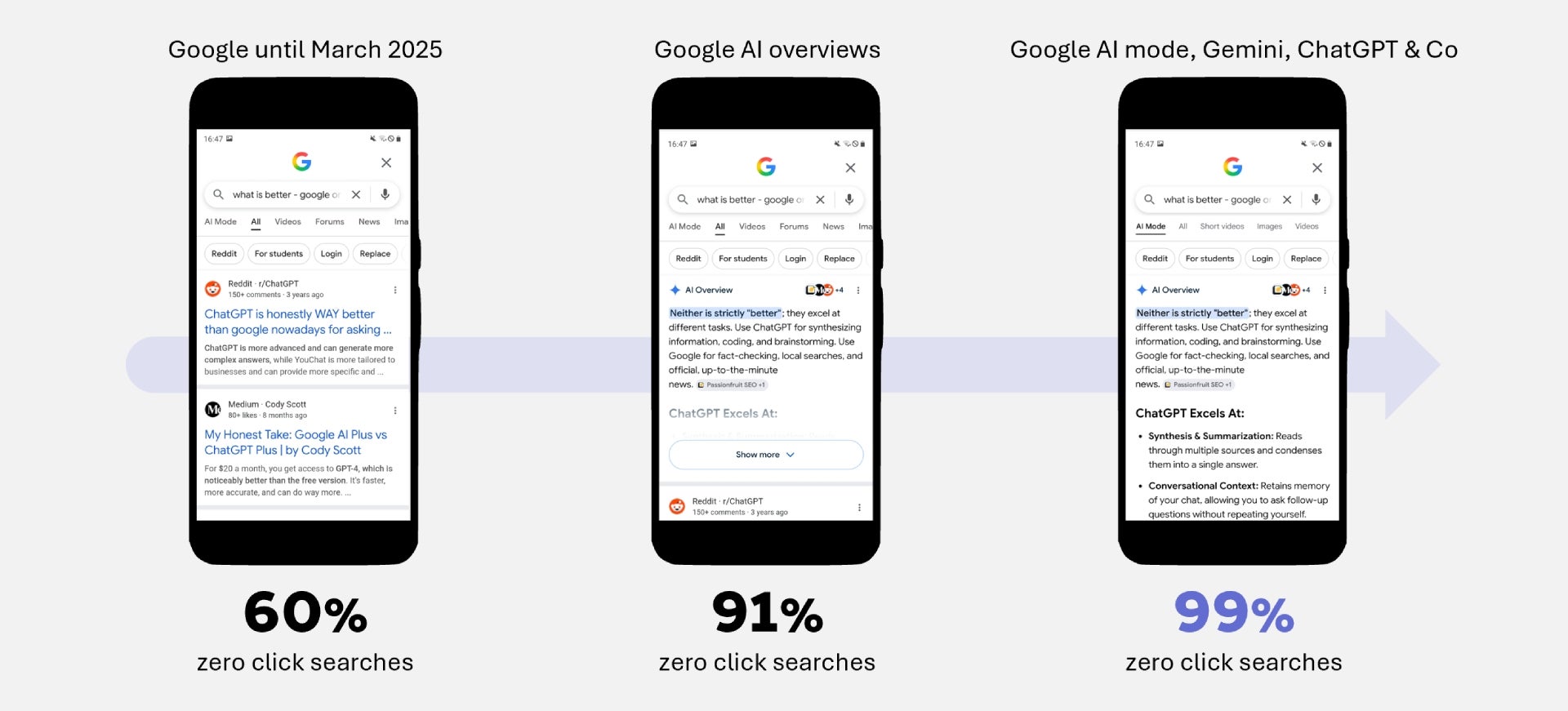
Search behaviour is shifting from “finding links” to “receiving answers.” In AI-driven environments, users are less likely to click through - instead, they rely on generated responses that combine information from multiple sources.
AI is changing how healthcare information is accessed and trusted:
- AI answers become the first point of contact for patients, caregivers and healthcare professionals
- Questions are answered with answers, not with lists of links
- Brand perception is shaped before measurable traffic appears
The implication is clear: visibility can no longer be defined by visits alone.
Zero Click 2.0: Visibility without visits
AI-generated summaries are accelerating what can be described as “Zero Click 2.0.” In many scenarios, the majority of queries are resolved without a click, fundamentally changing how digital performance is measured and managed.
For healthcare organisations, this introduces three connected risks:
- Outdated or inconsistent information may be surfaced by AI
- Content loses context when recombined across sources
- Compliance and governance become more complex
Websites remain relevant, but not primarily as destinations.
From destinations to source layers
The role of websites is shifting fundamentally: from audience destinations to structured content sources for AI systems. This means content must work for human audiences and machines alike by meeting three requirements:
- Information needs to be clearly structured and interpretable
- Trust signals must be visible and verifiable
- Technical delivery must ensure consistent accessibility
In this context, visibility is no longer about ranking, but about being selected, interpreted and cited by AI systems.
AI visibility requires a new foundation
AI visibility becomes the new foundation of digital relevance in healthcare and it is inherently cross-functional. It affects three dimensions within organisations:
- Content creation and medical approval processes
- Technical infrastructure and platform decisions
- Governance, ownership and accountability models
As a result, the challenge extends far beyond marketing or SEO.
Towards AI readiness in healthcare
To address this shift, organisations need to move from channel-based optimisation to structural readiness. This requires three priorities:
- Aligning content quality, consistency and governance across teams
- Ensuring technical accessibility and stability for AI systems
- Establishing clear ownership and cross-functional collaboration
AI visibility is not a standalone tactic. It is part of a broader organisational capability.
Download the full thought leadership piece
If AI answers define visibility before users interact with your brand, organisations need to rethink how content is created, structured and delivered. It is not just a content topic - it also touches governance, infrastructure and responsibilities across teams.
Download the whitepaper to explore the full framework

