

Written by Lala Asadova, Communications Executive
For years retail media has had a fairly straightforward job: find shoppers who are ready to buy and help brands convert them. It's an easy pitch: retailers sit closest to the point of purchase, they hold rich first-party data, and their platforms can actually tell us whether an ad led to a sale. In a channel where proving return on investment matters more, targeting people who are already showing purchase intent feels like the safest bet in media.
But there's an uncomfortable question underneath that safety, and it's one we don't ask enough. Would that person have bought anyway?
A shopper searching for cereal five minutes before checkout is very likely to convert, but their purchase may have already been close to certain before we ever showed them an ad. When thinking about retail media growth, if we only measure the sale, it's easy to mistake interception for creation. We see a strong ROAS figure and assume the advertising caused the purchase, when really it might have been a decision that was already made. This creates a gap between attribution and incrementality, and it's a gap that in-market-only retail media strategies tend to quietly paper over.
From capturing demand to influencing it
Imagine that same shopper searching for cereal. They're in-market, the intent is obvious, and serving them an ad in that moment can work really well. It's an easy win, and nobody's saying it isn't.
What this approach misses is the shopper who isn't searching for cereal today. The regular breakfast buyer who's loyal to a competitor. The household with kids who'd probably try a new flavour if they actually saw it. The person who's just never really considered the brand at all. None of them look "in-market" in the traditional sense, but plenty of them could still be genuinely valuable and influenced into making a purchase.
Retailer data can tell us a lot more than who's searching right now. It can surface purchasing behaviour, category engagement, brand relationships and shopping patterns over time, which changes the question we're really trying to answer. Instead of "who is ready to buy?" it becomes more like "who do we actually have an opportunity to influence?". That matters a lot when a brand is trying to grow penetration, launch something new, or win share off a competitor, because in those situations there might be very little direct purchase intent to target in the first place.
The commercial case, not just the strategic one
There's also a simpler reason to look beyond in-market targeting with retail media: it's getting more expensive. As more brands pile into the space, they end up bidding for the same, fairly small pool of shoppers who are already searching, which pushes up CPMs (cost per mile) on exactly the audience that offers the least incremental upside anyway. Chasing the same in-market shoppers as everyone else isn't just strategically narrow, it's becoming an inefficient way to spend money.
The brands doing well here aren't necessarily pulling budget away from conversion activity, they're just starting to realise that the audience with the highest ROAS and the audience with the highest actual value to the brand aren't always the same.
Retail media is moving beyond the point of purchase
The channel itself is already evolving in this direction. UK retail media grew 18% year-on-year to £3.8bn in 2025, and IAB UK has talked about its shift from shopper marketing into a proper part of full-funnel media strategy. Retailers are pushing beyond sponsored products and on-site placements into display, video, social, CTV and other off-site environments, and that changes what retail media can realistically do for a brand.
Rather than only reaching someone while they're mid-shop, brands can now use retailer audiences to reach people earlier, while they're discovering something, weighing it up, or just slowly forming a preference.
Nielsen's 2025 research backs this up too, noting that retail media is increasingly being used across the whole funnel, and off-site spend is expected to grow faster than on-site investment over the next few years.
The path to purchase can start a long time before someone types a product into a search bar, and retail media is increasingly able to play a part in that earlier stage rather than just the final one.
Incrementality as a core foundation of measurement
None of this really works if we keep measuring things the old way though. Last-click attribution will more or less always favour in-market, bottom-funnel activity, because it rewards whatever touchpoint happened to sit closest to the sale, regardless of whether that touchpoint actually changed anything.
To know whether upper-funnel activity is genuinely working, we need incrementality-focused retail media measurement sitting alongside attribution, not instead of it. This means:
- Holdout tests, where a comparable audience is withheld from exposure so we can compare purchase behaviour against those who saw the campaign
- Geo or matched-market testing, running the campaign in some regions and not others and comparing sales lift
- Media mix modelling, to get a sense of the combined and lagged effect of upper and lower funnel activity working together, rather than just crediting the last touch
This is also where the feedback loop starts to earn its keep. Retailer data helps us identify an audience up front, but what happens after we activate against it tells us something too. Did they purchase? Did they switch away from a competitor? Did they come back and buy again? That loop between media and commerce is something not many other channels can offer, making one of retail media's biggest long-term advantages over channels that can only report back impressions and clicks.
A layered approach to retail audience targeting
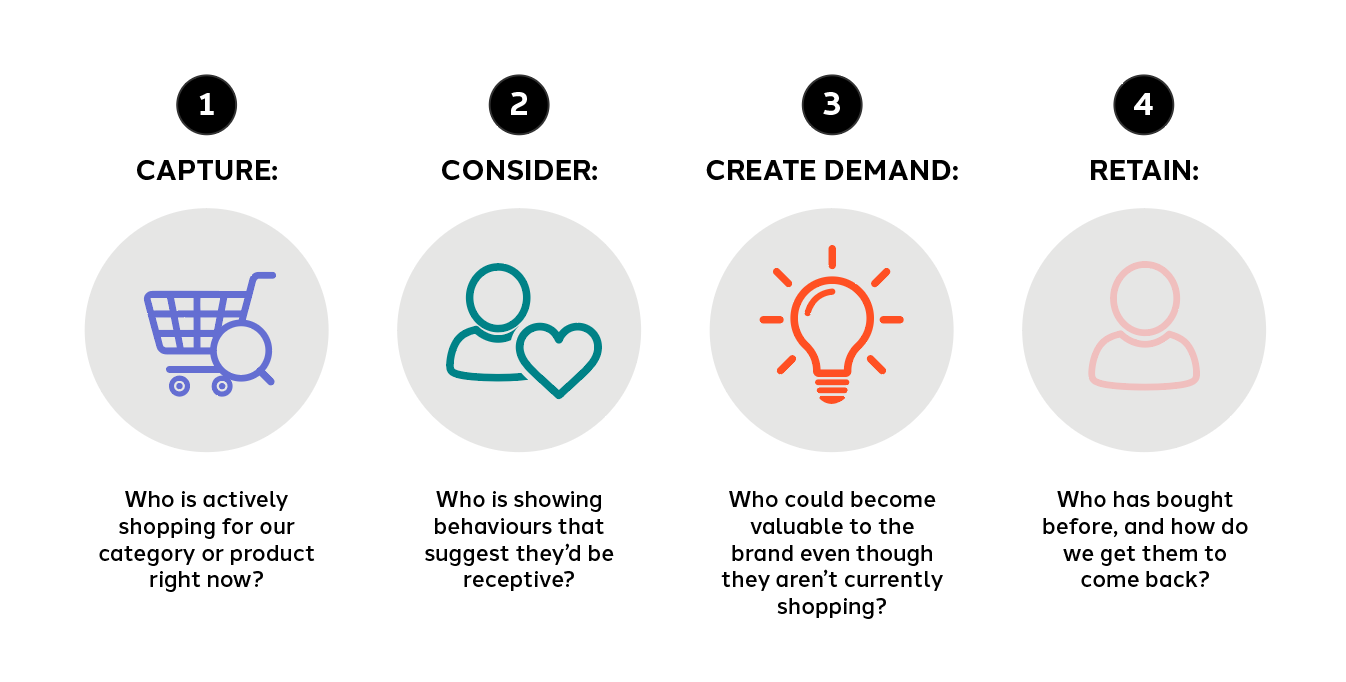
In-market audiences are still genuinely valuable, especially when the objective is pure conversion. But in-market isn’t the only layer of an audience strategy. A fuller model looks something like this:
- Capture: who is actively shopping for our category or product right now
- Consider: who is showing behaviours that suggest they'd be receptive
- Create demand: who could become valuable to the brand even though they aren't currently shopping
- Retain: who has bought before, and how do we get them to come back
This matters most for NPD (new product development) and category expansion, where there's often no existing pool of people actively searching for the product because it's new. In those cases, we have to look at behaviours around the category to work out who's most likely to try it, and that's where retail media's data advantage gets interesting. Most other channels don't have visibility into actual purchase behaviour at that level of detail.
The next opportunity for retail media
The real power of retail media isn't just knowing who's about to buy, it's understanding who might buy, why they might buy, and what would actually move them to pick our brand over someone else's.
In-market targeting will always matter, especially when the goal is to capture demand and drive conversion in the moment. But the bigger opportunity going forward is using commerce data and media together to influence behaviour earlier in the journey, work out what's genuinely driving incremental growth, and build relationships with shoppers over time, rather than just capturing the ones who were coming anyway.
So maybe the next step for retail media is less about reaching the shopper who's already ready to buy, and more about working out who we could influence into becoming our next one.

